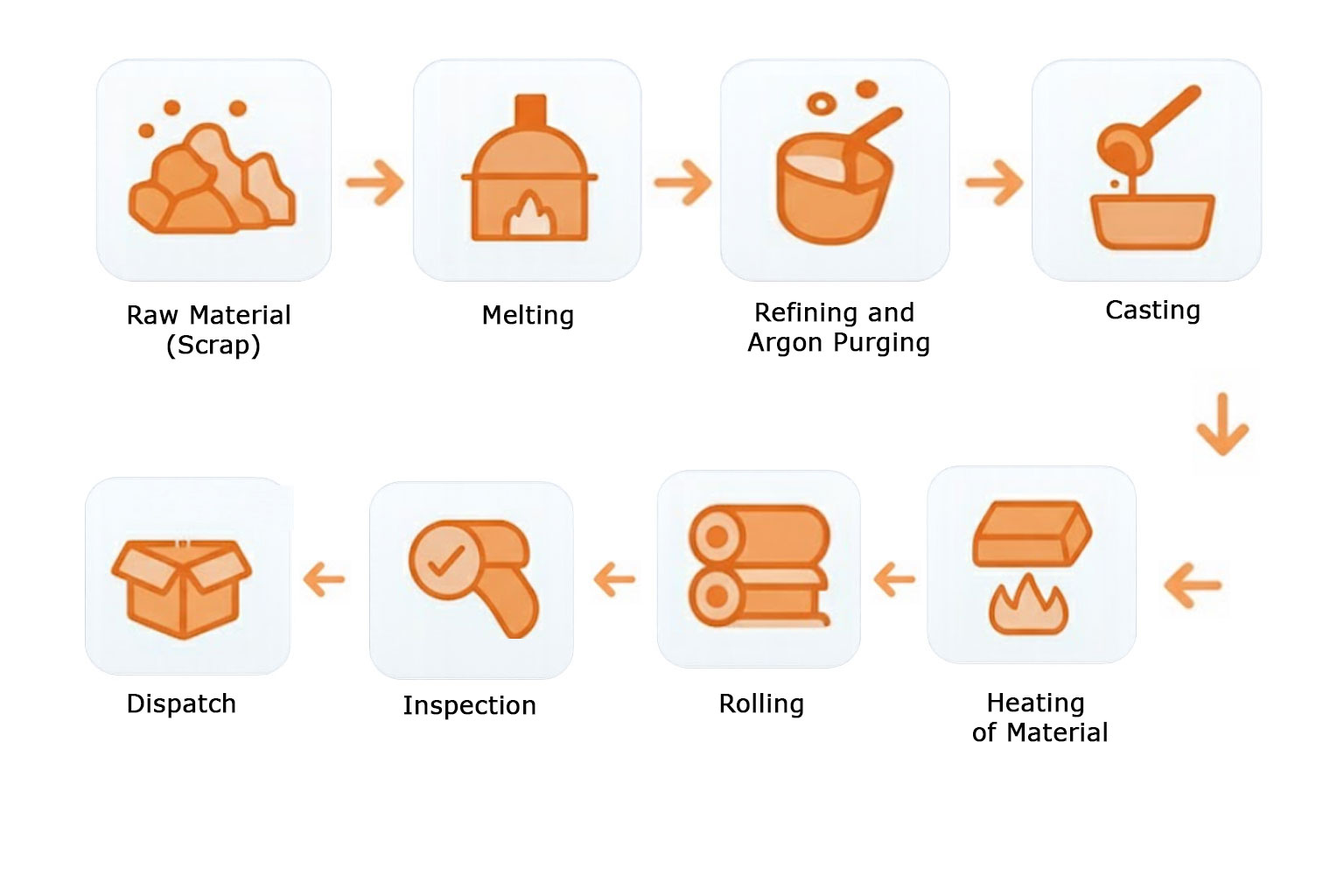
Raw Material(Scrap) :- We use the highest quality alloy steel scrap, including
forging scrap,
flash, turnings, and CRC and HR scrap. These materials
are meticulously
segregated based
on
their composition and quality to ensure consistency in the final product.
Melting:- The
selected scrap is charged into a furnace and heated to
extremely high
temperatures until it reaches a molten state. The specific
temperature and alloys addition
depend on the alloy steel’s composition and required properties.
Refining and Argon
Purging:- Once the scrap has melted, the molten steel
undergoes a
refining process to eliminate impurities. This involves slag removal, deoxidation, and grain
refinement, followed by argon purging to enhance purity and improve the material’s structural
integrity.
Casting:- The
purified molten steel is carefully poured into moulds using a
ladle. Hot tops are
placed over the moulds to prevent piping and ensure uniform solidification.
Ingot:- Once
solidified, the cast product, known as an ingot, undergoes
surface grinding to
remove any imperfections. This step ensures a smooth surface finish, which is critical for
high-quality rolling and final product formation.
Heating of
Material:- Before the ingots can be rolled, they are reheated in a
furnace to a
temperature ranging between 1,100°C and 1,200°C (Depanding on the grade and desired final
properties). This heating process enhances malleability, preventing cracks and defects during
rolling.
Rolling:- The
heated ingots are processed through rolling mills, where they
are progressively
reduced in size and shaped into the desired forms, such as round bars, hex bars, or Round
corner Square (RCS) bars. The number of rolling passes depends on the final dimensions and
product specifications..
Inspection:-
Following the rolling process, the steel bars undergo stringent
quality checks.
Magnetic Particle Inspection (MPI) is performed to detect any surface cracks, while (UTI)
Ultrasonic Testing ensures there are no internal defects, such as inclusions or piping.
Stacking and
Coding:- The inspected bars are then systematically stacked,
color-coded, and
marked with grade, size, and lot numbers for easy identification and traceability.
Dispatch:- The
finished steel bars are cut to size as per customer
requirements, securely
packaged, and dispatched for delivery.